
The piece argues that Marbella restaurant websites lose bookings when they are slow, hard to use on mobile, poorly localized, or dependent on third-party reservation platforms. It outlines five conversion pillars: mobile-friendly menus, multilingual local SEO, direct booking, stronger visual storytelling, and clearer outdoor dining logistics.
It then applies those standards to Soleo Marbella, identifying multilingual support as a strength but noting major weaknesses in menu presentation, booking flow, hero visuals, and seasonal lead capture. The article concludes that improving these areas can turn a website from a brochure into a direct booking tool.
Why Your Website Is Losing You Tables Before Guests Even Call
Marbella is one of Europe’s most competitive luxury dining markets. On any given summer evening, a high-net-worth couple visiting from Moscow, Riyadh, or London will open their phone at 7 PM, browse three or four restaurant websites in under four minutes, and book the one that made it easiest. Not necessarily the best food. The easiest booking.
That’s the brutal economics of digital hospitality. A restaurant on the Golden Mile can invest €400,000 in interior design, hire a Michelin-pedigreed chef, and still lose a €600 table to a competitor with a faster website and a cleaner reservation flow. The gap between a restaurant that’s fully booked and one that’s half-empty at peak season is increasingly decided not in the kitchen — but in the browser.
This article breaks down the five structural pillars that separate high-converting restaurant websites from expensive digital brochures. It ends with a detailed case study of Soleo Marbella: what they’re doing right, where they’re bleeding bookings, and exactly how to fix it.
The Marbella Dining Market: What Makes It Different
Before diagnosing problems, it’s worth understanding what makes the Marbella market uniquely demanding for digital execution.
The Costa del Sol receives over 12 million tourists annually, with Marbella and its surrounding municipalities — San Pedro de Alcántara, Nueva Andalucía, Puerto Banús, Benahavís — attracting a disproportionately affluent segment. The resident population is itself multi-national: British, Swedish, German, Russian, Arabic, and Spanish communities coexist across the municipality’s urbanizaciones and golf valleys. A restaurant’s digital presence must therefore perform for guests who are searching in different languages, on different devices, from different countries — sometimes from a sun lounger on the beach two kilometres away, sometimes from an apartment in Mayfair six weeks in advance.
Over 75% of local restaurant discovery now happens on mobile devices. That single statistic should re-architect every decision a Marbella restaurant makes about its website.
The market also has a distinct seasonal rhythm. Peak season (June through September) generates a disproportionate share of annual revenue. Restaurants that fail to capture bookings efficiently during this window — or fail to build a prospect list during the off-season — find themselves starting from scratch every March.
Pillar 1: Mobile-First Menu Architecture
The Problem
Walk into virtually any upscale Marbella restaurant’s website on a mobile phone and click “Menu.” In a depressing number of cases, what follows is one of two things: a browser tab struggling to render a multi-megabyte PDF, or a redirect to a separate page that breaks the browsing session entirely.
This is a critical conversion failure. The menu is not supplementary information — it is the primary sales document of a restaurant. It is the moment a potential guest moves from curiosity to intent. A menu that is slow, illegible, or inaccessible on mobile does not just frustrate; it ends the booking journey.
The PDF problem is particularly acute in Marbella. A typical printed menu scanned or exported to PDF runs between 3MB and 8MB. On a 4G connection at the beach — fluctuating between adequate and poor — that file can take 15 to 40 seconds to open. Research on mobile user behaviour consistently shows that the majority of users abandon a page that takes longer than three seconds to load. A restaurant is not exempt from that psychology simply because its terrace is beautiful.
The Standard
A high-converting menu is built as responsive HTML directly inside the website. It loads in under one second on any connection. It is legible at the default text size on any screen without pinching or zooming. Dish names, descriptions, allergen notes, and prices are text — not images of text — which means they are searchable, readable by screen readers, and indexable by Google.
The SEO benefit alone justifies the rebuild. When a potential guest searches “tuna tataki Marbella” or “gluten free beachfront restaurant Marbella,” a restaurant with a text-based HTML menu has a structural advantage over one hiding its dishes inside a PDF file that search engines cannot read.
The best implementations add a lightweight visual layer: a tap on a dish name opens a high-quality photograph in a popup overlay. The menu itself stays fast; the photography loads only when requested.
The Diagnostic Test
Open your restaurant’s website on your personal mobile phone using mobile data, not Wi-Fi. Tap “Menu.” Time how long it takes before you can read a dish name and a price. If the answer is more than two seconds, you have a problem that is costing you bookings every day of the season.
Pillar 2: Integrated, Multilingual Local SEO
The Problem
Marbella is not a monolingual market. The dining audience breaks down roughly as follows: English-speaking guests (British, Irish, American, and Northern European anglophone) represent approximately 45–50% of the high-value tourist segment. Spanish-speaking guests — both domestic tourists and long-term residents — represent 30–35%. The remaining 15–20% is a mosaic of Russian, Arabic, French, German, and Swedish speakers, with significant variation by neighbourhood and season.
A restaurant that operates an English-only website is structuring itself to compete for roughly half the market. A Spanish-only website does marginally better but still excludes most tourists entirely. Browser auto-translate — the technology that many restaurants implicitly rely on — is not a solution. Automated translation mangles culinary vocabulary in ways that range from comical to off-putting. A well-crafted dish description like “huevo de corral a baja temperatura con trufa negra y jamón ibérico de bellota” does not survive machine translation into any language with its appetite appeal intact.
The SEO dimension is equally important and often completely overlooked. Google’s local search algorithm is highly geographic. A search for “fine dining Nueva Andalucía” returns different results than “fine dining Marbella” — the algorithm uses schema markup, address data, and page content to determine which searches a business is relevant for. Most restaurant websites have no structured geographic data at all, which means they are invisible for neighbourhood-level queries at precisely the moment a guest is deciding where to eat tonight.
The Standard
At minimum, a Marbella restaurant website should provide genuinely localised English and Spanish versions — not translated, but written for each audience by someone who understands what each demographic values. A British guest browsing for a special-occasion dinner is responding to different signals than a Spanish family celebrating a birthday. The copy, the imagery hierarchy, and even the calls to action can reflect this.
For restaurants in areas with strong Russian, French, German, or Arabic communities — the golf valleys of Nueva Andalucía, the marina at Puerto Banús, the residential areas of La Zagaleta — adding a third language is not a luxury but a revenue decision.
On the technical side, every page should carry schema.org LocalBusiness markup with precise geographic coordinates, neighbourhood identifiers, and opening hours. This is the data layer that Google reads when deciding whether to surface your restaurant in a “restaurants near me” or “beachfront dining Marbella” search.
The Diagnostic Test
Open a private browser window and search for your restaurant category plus your specific neighbourhood — “chiringuito San Pedro de Alcántara” or “steakhouse Nueva Andalucía,” for example. If your restaurant does not appear on the first results page, your geographic SEO is not working. Now check whether your website has an accessible language toggle. If it does, switch to Spanish and read the first paragraph of your homepage copy. If it reads like it was produced by a translation algorithm rather than a human, that is exactly what your Spanish-speaking visitors are experiencing.
Pillar 3: Frictionless, Zero-Commission Booking Flow
The Problem
This is the pillar where the most money is lost, and where the gap between common practice and best practice is largest.
The dominant booking model for restaurants in Marbella currently involves integration with third-party reservation platforms — TheFork (ElTenedor in Spanish markets), CoverManager, or similar services. These platforms serve a discovery function: they aggregate restaurants and allow users to browse options. That discovery value is legitimate. But when a restaurant uses a third-party platform as its only booking mechanism — routing all website visitors to an external portal to complete their reservation — it is making three expensive mistakes simultaneously.
First, it introduces friction. Every redirect in a digital journey produces drop-off. Industry data consistently shows that each additional click or page transition required to complete a booking reduces completed reservations by 12–15%. Sending a guest from your website to an external platform to complete a booking is introducing at minimum two to three additional steps into a process that should take under sixty seconds.
Second, it exposes the guest to competitors. TheFork and CoverManager are comparison platforms. When a guest arrives on the booking page for your restaurant via one of these services, they are surrounded by other options. The guest who arrived from your website — already interested, already engaged — is now being shown a curated list of nearby alternatives. Some percentage of them will be distracted. This is not a hypothetical: it is the designed function of an aggregator platform.
Third, it is expensive. Commission structures on major booking platforms typically run between 2€ and 4€ per cover, with some premium placement products costing more. For a restaurant doing 80 covers per night at peak season, across 120 peak nights, that commission exposure can reach €38,000 to €57,000 per year. That is not a distribution cost — it is a digital failure cost.
The Standard
A restaurant website should contain a native, embedded reservation widget that allows a guest to select a date, time, party size, and any available preferences — terrace versus indoor, dietary requirements, special occasions — without leaving the website’s visual environment. The booking journey should feel like part of the restaurant experience, not a bureaucratic handoff to a third-party system.
The secondary benefits compound significantly. A direct booking system means the restaurant owns its guest data: email addresses, dining frequency, dietary preferences, occasion history. This data is the foundation of every off-season marketing campaign, every birthday promotion, every VIP re-engagement initiative. A restaurant that books exclusively through third-party platforms owns none of this data. It starts every season from zero relationship.
The up-sell potential is also worth quantifying. A native booking flow can offer optional enhancements at the point of reservation: a bottle of champagne on arrival (€95), a terrace upgrade with sea view (€20 minimum spend increase), a pre-selected tasting menu for groups. These enhancements, presented as optional selections during the booking process, regularly increase average cover value by 15–25% and add no additional labour cost.
The Diagnostic Test
Click “Book a Table” on your own website. Note whether you are kept within your website’s domain or redirected to an external URL. If you are redirected, calculate your approximate annual commission exposure at your average covers per night and your average peak season duration. Then ask whether that sum would pay for a custom booking integration.
Pillar 4: Rich Media That Sells the Atmosphere, Not Just the Food
The Problem
In Marbella, guests are not purchasing a meal. They are purchasing an experience, a social context, a memory. The decision to book a table at a specific venue is emotional before it is rational — the feeling of anticipation, of social aspiration, of imagining oneself in that space on a warm evening.
A static photograph of an empty dining room, taken during the day with natural light, does not create that feeling. Neither do images that appear to have been taken with a smartphone on a slow Tuesday. Yet these are the dominant visual assets on the majority of Marbella restaurant websites.
The disconnect is significant. A restaurant may spend €15,000 on a professional interior design shoot for its social media, then embed a compressed JPEG of the terrace as the homepage header and consider the job done. The homepage is the first impression. It is where the emotional decision is made or abandoned. It deserves the same investment as the physical space.
The Standard
The homepage hero section — the area visible before any scrolling — should feature a high-definition looping video that shows the venue in its most animated, desirable state. This means evening service, not an empty afternoon. Candlelight and conversation, not vacant chairs. The sea at golden hour, not the parking access road. The video should be short (15–30 seconds), muted by default, and compressed appropriately for fast mobile loading — modern H.264 compression can deliver excellent quality at under 8MB.
Beyond the hero, the visual architecture of the website should communicate what it actually feels like to be in the venue at its best moment. This includes: the energy of a full terrace during peak service, the texture of the food at its most photogenic, the detail of the space — tablecloths, lighting, glassware — that communicates quality to a guest who has not yet visited.
Dress code and atmosphere-setting copy also belong here. Explicitly communicating that the venue is smart casual or formal, that the terrace is outdoor and subject to the coastal breeze, that the energy is social and convivial rather than hushed and intimate — this information serves a pre-qualification function. It ensures that the guests who arrive are aligned with the experience the venue is designed to deliver. The result is fewer mismatches, better reviews, and guests who are primed to enjoy themselves before they sit down.
The Diagnostic Test
Open your website’s homepage and time how long it takes before you feel something — a sense of atmosphere, a desire to be there. If the answer is “I need to scroll to a gallery page,” the hero section is not doing its job. Ask a friend who has never visited your restaurant to look at the homepage for ten seconds, then describe what kind of experience they imagine. Their answer will tell you whether your visuals are communicating what you intend.
Pillar 5: Smart Logistics for Outdoor and Seasonal Dining
The Problem
The Costa del Sol’s climate is the primary driver of Marbella’s hospitality economy. Guests are booking outdoor experiences — beachfront tables, rooftop terraces, garden settings, chiringuito sunbeds — not just meals. This means the logistics of outdoor dining are not supplementary information: they are central to the booking decision and the guest experience.
Most restaurant websites handle this category of information badly. Outdoor availability is implied but not confirmed. Seating areas are described in vague terms. Minimum spends for premium terrace tables are disclosed only at the point of arrival — if at all. Weather contingency policies are absent entirely. The result is a stream of phone calls asking the same three questions, a percentage of which end without a booking, and a proportion of which result in disappointed guests who arrive expecting one thing and experience another.
The Standard
A sophisticated outdoor and seasonal logistics setup on a restaurant website has three components.
The first is a visual seating map integrated into the booking flow. Rather than selecting a generic table, a guest can select a seating area — Front-Line Sea View, Garden Terrace, Indoor Air-Conditioned Salón, Bar Seating — with a brief visual representation of each zone. This transforms a functional step in the booking process into an experience-enhancing decision, and it manages expectations precisely, reducing the friction of arrival.
The second is automated minimum spend communication. For premium tables — VIP terrace positions, sunset-facing locations, weekend prime service — the booking engine should display minimum spend requirements as part of the table selection, not as a surprise at the end of the evening. Guests who are comfortable with a €200 minimum spend are not deterred by seeing it clearly stated; they are reassured by the transparency. Guests who are not comfortable are filtered out before a failed booking experience occurs.
The third is a published weather contingency policy. The levante wind blows consistently off the eastern coast. Coastal fog occurs. Unexpected rain is rare but not unknown. A clear policy — “In the event of adverse weather conditions, all outdoor reservations are reassigned to our covered terrace or indoor salón, with the same menu and service” — removes uncertainty from the guest’s pre-booking calculation. Uncertainty leads to hesitation. Hesitation leads to searching for an alternative.
The Diagnostic Test
Without using the phone or email, try to determine the following from your restaurant website alone: whether you have outdoor seating, what type of outdoor seating it is, whether there is a minimum spend requirement for specific areas, and what happens to your booking if it rains. Count how many of those four questions your website answers clearly. If the answer is fewer than three, you are generating unnecessary telephone traffic and losing guests who abandon the process before picking up the phone.
Case Study: Soleo Marbella
Soleo Marbella is a beachfront restaurant operating in one of the most competitive locations on the Costa del Sol — the Marbella coastline, within easy reach of both the Golden Mile and the Marbella town centre. The venue has a strong brand identity anchored in its combination of Josper grill cooking, premium Almadraba bluefin tuna, and a coastal design aesthetic attributed to interior designer Isabel López Vilalta. Its marketing positioning — “Sea, fire, and mountains” — is evocative and distinctive.
| Area | Score | Priority |
|---|---|---|
| Mobile Experience | 8/10 | Medium |
| Reservations | 7/10 | High |
| Menu Presentation | 8/10 | Medium |
| Multilingual SEO | 6/10 | High |
| Conversion Path | 7/10 | High |
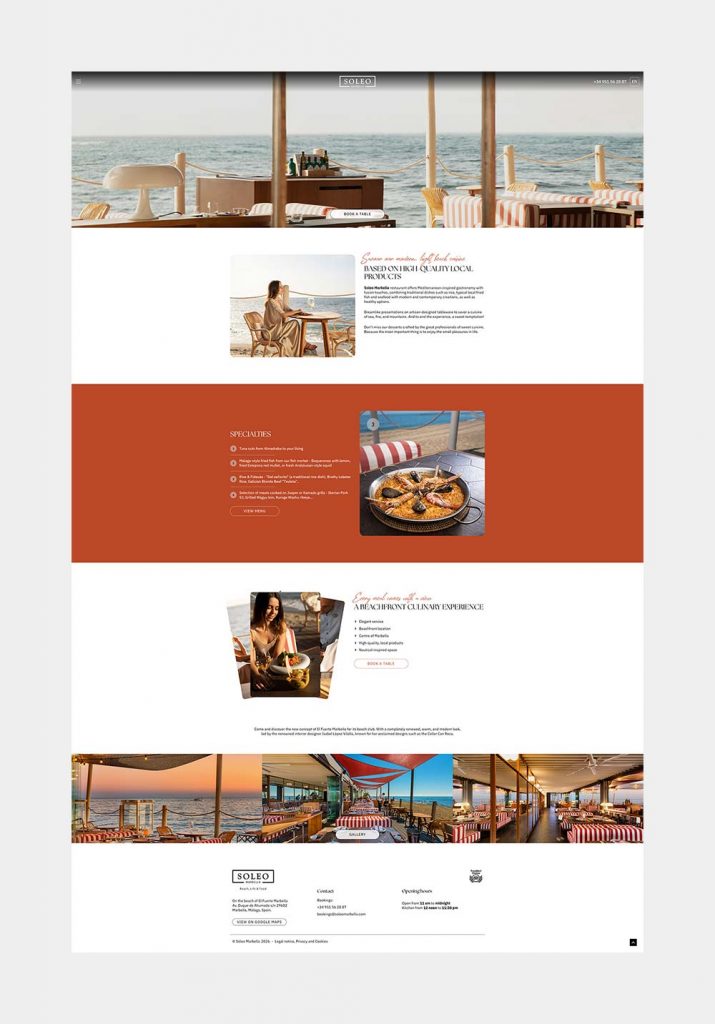
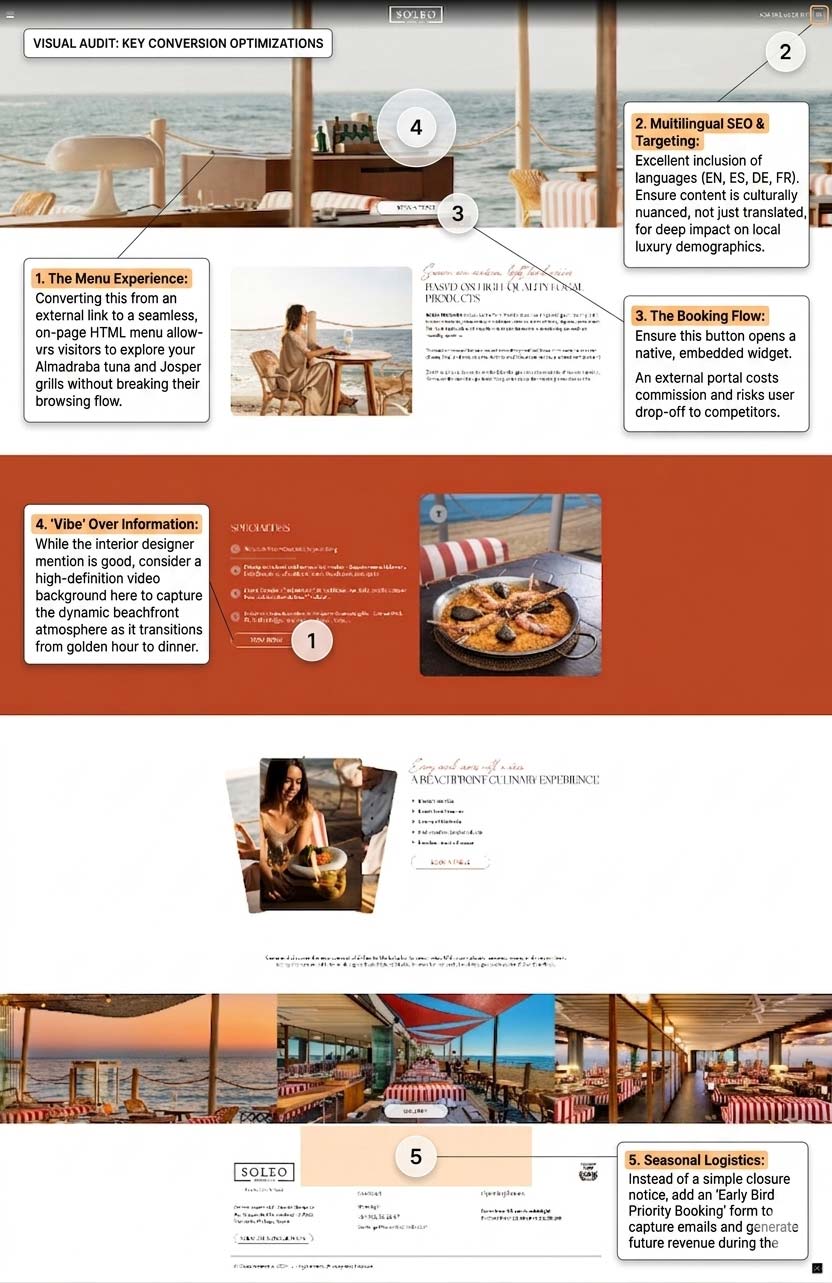
This analysis evaluates the website against each of the five conversion pillars, identifies the specific friction points where bookings are being lost, and provides actionable recommendations for each.
Pillar 1 — Menu Experience: Needs Attention
The website features a “View Menu” button, which is a positive signal. The presence of a clear menu access point in the navigation demonstrates that the team understands its importance.
However, the implementation creates a break in the user journey. Rather than displaying the menu as an integrated component of the website experience, the flow directs users to a separate page or external document. For a guest browsing on mobile — the majority of Soleo’s likely web visitors — this interrupts the session at precisely the moment of highest food-related curiosity.
The menu itself, based on the website content, features significant premium anchors: Almadraba tuna preparations, Josper-grilled meats, and market-driven seafood. These are exactly the dishes that need to be displayed in a way that builds desire — with names that are readable, descriptions that are scannable, and photography that is aspirational. A PDF or secondary page does none of these things efficiently.
Recommendation: Rebuild the menu as an on-page HTML component, tabbed by course if necessary (Starters, Fish, Meat, Desserts). Each section should be visible without a page redirect. Where photography is available, implement a tap-to-reveal system so that dish images load on demand without slowing the initial page render. This single change is likely to have the highest direct impact on mobile conversion of any technical modification.
Pillar 2 — Multilingual SEO: A Clear Strength
This is the area where Soleo’s website performs most strongly relative to the competitive set. The presence of language toggles for English, Spanish, German, and French is genuinely unusual among Marbella restaurants at any price point. It demonstrates an understanding of the multinational nature of the local market that many competitors lack entirely.
The caveat — and it is an important one — is that the value of language toggles is entirely dependent on the quality of the content within each language version. If the Spanish, German, and French versions are machine-translated or directly transposed from the English copy, they will perform poorly on two dimensions simultaneously: the guest experience will feel generic and occasionally awkward, and the SEO benefit will be limited because search engines reward locally relevant, naturally written content.
The highest-value refinement in this pillar is to commission brief but culturally informed rewrites of the core pages — homepage, about, and menu introduction — in each active language. A German guest and a British guest reading about the same restaurant should feel that the text was written for them specifically, not translated for them approximately. The investment is modest relative to the revenue potential of the German and northern European market on the Costa del Sol.
Additionally, the geographic schema implementation should be audited. If the website’s structured data declares only “Marbella” as its location rather than the specific coastal zone, it is potentially missing neighbourhood-level searches that drive significant last-minute booking traffic.
Top 3 Opportunities
✓ Improve multilingual SEO targeting tourist searches
✓ Reduce clicks to reservation completion
✓ Enhance seasonal content and event visibility
Pillar 3 — Booking Flow: The Most Significant Vulnerability
Based on the current website structure, the “Book a Table” call to action routes through an external or semi-external booking mechanism. This is the single most commercially significant problem on the site.
The issue is structural rather than cosmetic, and fixing it requires a decision about booking infrastructure rather than a design update. There are several direct-booking solutions appropriate for a venue of Soleo’s positioning — ResDiary, SevenRooms, and Resy all offer embedded widget integrations that keep the guest within the restaurant’s visual environment throughout the reservation process, while providing the backend management tools (table allocation, covers reporting, customer records) that a modern restaurant operation requires.
The commission exposure on a beachfront venue with Soleo’s likely peak-season volume is substantial. More importantly, the data loss is irreversible: every booking completed through a third-party platform is a guest relationship that the restaurant does not own. When the season ends and marketing for the next opening begins, a restaurant with a direct-booking database has a built-in communication channel; a restaurant without one has to start from zero.
The implementation recommendation is specific: the “Book a Table” button should open an overlay modal within the same browser window, maintaining the Soleo visual identity throughout. The flow should accommodate date, time, party size, and a free-text field for dietary notes or special occasions. Optional enhancements — terrace preference, champagne on arrival — can be offered at step three without complicating the core flow. The entire journey from button click to confirmation email should take under ninety seconds.
Pillar 4 — Vibe and Atmosphere: Strong Concept, Underserved by Execution
The copy on the Soleo website is a genuine asset. “Sea, fire, and mountains” is a headline that earns its place — it communicates the elemental quality of the experience efficiently and memorably. The reference to Isabel López Vilalta as interior designer provides social proof that will register with a design-conscious, affluent audience. These are not small things; many competitors have neither a coherent brand narrative nor a design credential worth mentioning.
The gap is in the visual execution, specifically in the hero section. A beachfront restaurant on the Marbella coast has, in theory, some of the most cinematically compelling source material available to any dining establishment in Europe: the Mediterranean at different times of day, a Josper grill in full operation producing visible smoke and fire, a terrace in full service at dusk. None of this is presently being used to its maximum effect.
The recommendation here is high-impact and relatively straightforward to execute: commission a half-day video shoot during peak evening service. The resulting footage — 90 seconds to 2 minutes of raw material — can be edited into a 20-second looping homepage hero, a 60-second social media reel, and a series of still frames for use throughout the site. The cost of a professional videography session appropriate for a venue of this positioning is typically €800 to €1,500. The conversion impact of a hero section that shows the venue alive, lit, and in full service is measurable in the first week.
The secondary visual priority is a before-and-after sequence showing the same space across different times of day — the beach at noon, the terrace at golden hour, the interior at full evening service. This communicates that Soleo operates as both a lunch destination and an evening venue, which doubles the potential booking occasions in the mind of a guest.
Pillar 5 — Seasonal Logistics: A Missed Opportunity That Extends Beyond the Season
The website currently communicates seasonal closure status clearly. This is better than leaving visitors to discover a closed restaurant upon arrival. However, the treatment of the closure notice represents a missed revenue opportunity of considerable scale.
A beachfront Marbella restaurant closing for the winter is not a dead period for the website — it is the beginning of the next season’s booking pipeline. The guests most likely to book the best tables in the first weeks of the new season are exactly the guests who visited the website during the closure, found a static “Closed — Reopening in March” notice, and left without any mechanism for follow-up contact.
The immediate recommendation is to replace the static closure notice with an active lead capture form: “Secure your place for the season. Join our priority list and be the first to reserve a terrace table for our reopening in March.” This converts what is currently a dead-end page visit into an email list entry. A list of 400–600 engaged, high-intent subscribers built during the off-season is a launch asset worth more than any paid advertising campaign.
For the active season, Soleo would benefit from more explicit outdoor logistics communication on the booking page. Specifically: the distinction between the sea-facing terrace and the indoor dining room, the availability of each for private and group bookings, any minimum spend requirements for premium positions, and the policy for outdoor reservations in the event of coastal wind or weather. The Costa del Sol’s climate is the venue’s primary selling point; its management during edge-case conditions should be communicated as a service, not left as an anxiety.
Web Design Marbella Insight
Restaurants in Marbella compete for international traffic. A website that combines multilingual SEO, streamlined reservations, and mobile-first design often converts significantly better than a brochure-style website.
Summary of Recommendations
Across the five pillars, the priority ranking for Soleo Marbella — ordered by commercial impact — is as follows.
The booking flow is the highest priority. A native embedded reservation system eliminates commission exposure, captures guest data, and removes the single most damaging friction point in the conversion journey. This is a six-to-eight week project and the most commercially significant investment on this list.
The hero video is the second priority. It requires one production day and transforms the emotional impact of the first ten seconds of every website visit. This should happen before the next season’s opening.
The menu architecture is the third priority. Converting to an HTML on-page format improves mobile experience, supports SEO, and keeps guests in the browsing flow at the moment of highest purchase intent. This is a technical task that can be completed independently of the booking system migration.
The off-season lead capture mechanism is the fourth priority, primarily because it is time-sensitive. Every week the closure notice runs without an email capture form is a week of potential database-building that cannot be recovered.
The multilingual content audit is the fifth priority, not because it is less important in the long run, but because the other four items represent immediate conversion losses, whereas the language quality issue is a slower-burning drag on the ceiling of the site’s performance.
A website that executes these five pillars correctly is not a digital brochure. It is a booking engine operating 24 hours a day, in multiple languages, converting visitor interest into confirmed reservations without requiring a phone call or a walk-in. In a market as competitive and as seasonal as Marbella, that infrastructure is not a marketing expense. It is a core business asset.
Visit Soleo Official Website
www.soleomarbella.com
How to Build Your Own Personal Website from Scratch
Top Tools for Web Designers and Developers in 2026
Top Web Design Trends to Watch This Year
How to Increase Website Engagement with Interactive Content
How to Build Ultra-Fast, “No-Template” WordPress Sites for High-End Clients
